
The conflict with Iran may be remembered not for its geography, but for how it was fought. With limited ground presence and only narrow, targeted deployments, it resembled something new. This was a war defined less by troops and territory than by data, computation, and speed. It may prove to be the first true AI-enabled conflict.

The defining shift was not the presence of artificial intelligence itself, but its role. AI systems ingested vast streams of sensor data, generated and prioritized targets, and compressed decision cycles from hours to minutes, and in some cases seconds. The constraint in modern warfare is no longer the ability to generate insight. It is the ability to act on it.
Pentagon’s Maven Smart System used AI to process data from sensors, satellite imagery, and other sources to enable rapid targeting decisions. The U.S. military says it hit about 1,000 targets in Iran during the first 24 hours of attacks, double the number struck during the 2003 “shock and awe” campaign in Iraq.
// The Old Model Breaks
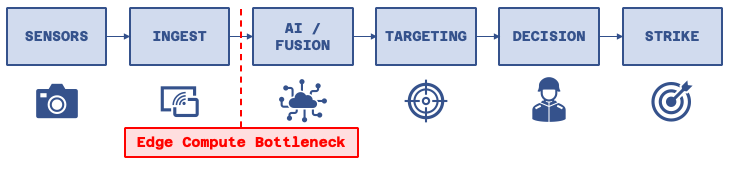
For decades, militaries assumed that data could be transmitted back to centralized systems for processing. The cloud and large, fixed data centers formed the computational backbone of operations. That assumption no longer holds. In future conflicts with near peer adversaries, connectivity will be contested, intermittent, and often degraded. These conditions are known as (DDIL) denied, degraded, intermittent, or limited environments. In such settings, reliance on distant compute becomes a liability. Latency increases, data pipelines fail, and the speed advantage promised by AI collapses.
// Compute Becomes the Battlefield
The conflict revealed a more fundamental shift. Data centers themselves became strategic assets and, in some cases, targets. The infrastructure that performs computation is now part of the battlefield. Disrupting compute is not a supporting action. It is a direct attack on the system’s ability to decide and act.
Compute is no longer a back-end function. It is a platform within the kill chain. The modern kill chain runs from sensors to ingestion, fusion, targeting, decision, and execution. AI now accelerates each stage. But it only works if compute is available where the data is generated. When compute is distant, inaccessible, or disrupted, the chain breaks.
// The Answer
The answer is not more centralized infrastructure. It is the opposite. Compute must move to the edge.
Edge computing places GPU-powered processing directly within the operational environment. It allows AI models to run locally, without reliance on constant connectivity. It reduces latency between detection and action. It enables systems to function in environments where networks cannot be trusted.

// An Operational Requirement
This is not a matter of technical preference. It is an operational requirement. When decision cycles are measured in seconds, the delay introduced by transmitting data across contested networks is unacceptable. AI that cannot execute in real time is of limited value.
Systems must also be built to survive in denied, degraded, intermittent, or limited environments. That requires resilient, self-contained platforms capable of operating independently of traditional infrastructure. Mobility, security, and the ability to deploy rapidly are no longer advantages. They are prerequisites.
The result is real-time execution. When compute is co-located with data, the gap between detection and response collapses. AI moves from analysis to operation. The broader implication is clear. The locus of advantage in warfare has shifted to information, computation, and speed. Forces that can process data faster and act faster will define the outcome of future conflicts.
If the Iran war is the first AI war, it has already delivered its central lesson. The side that controls not just data, but the ability to compute on that data at the edge, will shape the future of warfare.