
As AI models grow larger and data moves to the edge, the hard problem is no longer intelligence. It is where that intelligence can physically run.
// The Problem
A new kind of bottleneck.
Most AI strategies still assume reliable access to centralized cloud infrastructure. That assumption is breaking down. As AI models grow larger and data generation accelerates, the constraint on deployment is no longer the intelligence itself: it’s where that intelligence can physically run. Bandwidth limits, latency, contested networks, and disconnected environments are creating a new infrastructure bottleneck across defense, government, and industrial operations alike.
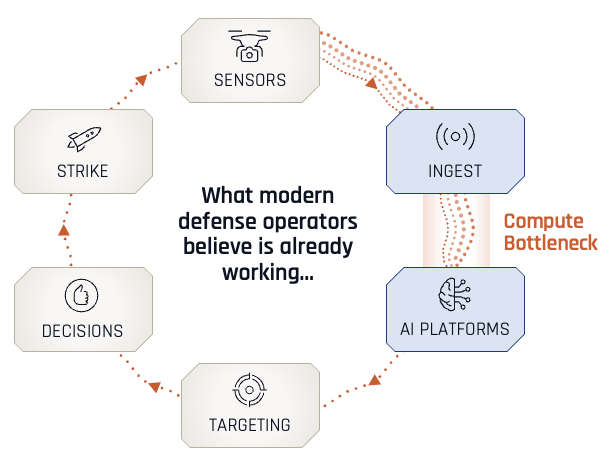
For decades, compute was centralized by default: collect data at the edge, ship it to a datacenter, process it there. That model held up when applications could tolerate delay and connectivity was a safe assumption. AI breaks both of those assumptions: modern workloads demand dense GPU compute close to where data is generated, and the environments generating that data are frequently mobile, disconnected, or operationally hostile to a traditional data center.
// Problem to Solution
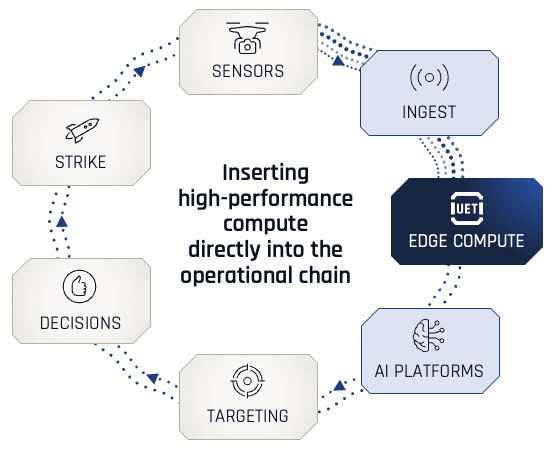
Inserting compute into the loop.
The same operational loop, shown with and without high-performance compute at the edge.
// The Stakes
Compute placement is becoming strategic.
Access to capable AI models is no longer the differentiator.
Most organizations have that today. The differentiator is the ability to operationalize those models where connectivity, power, and facilities can’t be assumed: aboard a vehicle, at a forward site, inside a contested network. Organizations that solve compute placement will define the next phase of operational AI; those that don’t will stay tied to infrastructure that can’t follow the mission.
// The Answer
Where UET fits.
UET builds VectorEdge, a liquid-cooled, ruggedized compute platform designed around exactly this constraint: high-density GPU performance in a footprint that can deploy wherever the data is, without the HVAC, connectivity, or facility requirements a traditional data center demands. The pods are the enabling technology. The problem they solve, getting real AI compute to the point of need, is the reason UET exists.
The organizations that win the next decade of AI deployment won’t just have the best models. They’ll be the ones who can put compute wherever the mission requires it.