
The Army’s latest desert test shows battlefield AI is limited less by algorithms than by the hardware, power and networks that must survive where soldiers fight.

This July, 9,700 soldiers spent ten days fighting a round-the-clock mock battle in the Mojave Desert at Fort Irwin. July is the hottest month of the year in this region, with average daytime highs in excess of 100°F. The Army billed Project Convergence as a look “inside the U.S. Army’s AI-enabled battlefield”: AI applications, data integration, aerial and ground drones, sensor-loaded headsets. The Wall Street Journal’s account is required reading for anyone building for this customer.
One line stood out to us. During the exercise, soldiers flew drones “without full autonomy or any AI to assist.” The software exists. There is no shortage of AI applications being developed for the military, with billions of dollars being invested in the technology. Walk the trade show floor at virtually any defense industry conference and you’ll see everything from AI-enabled drone navigation to intelligence analysis, battlefield surveillance, and targeting systems. The industry is investing heavily in developing these capabilities, but far less attention is being paid to the infrastructure required to run them where soldiers actually operate. What failed to show up at Project Convergence was the compute, power and connectivity needed to run these AI applications where the soldier stands. A military force with access to extraordinary AI capabilities thousands of miles away may still find itself technologically disadvantaged if those capabilities cannot operate where decisions are being made.
// Hardware Challenges in the Field
“You take a piece of electronics and lay it out on a hot rock in 109 degree temperatures and try and make it work,” said Lt. Gen. Michael McCurry, one of the senior leaders running the event. “We’re seeing some of that.” The article continued, “Servers overheated. Batteries died and couldn’t be recharged. Soldiers drenched T-shirts in ice water and draped them over antennas that were on the fritz.” The frustration with industry among soldiers on the ground was captured by Sgt. Ramontez Bennett’s comment about a drone he’d been working with: “They gotta do something about it overheating.”
These failures highlight a larger challenge facing the military as it works to integrate AI into its operations. The technology is advancing rapidly in the lab, but the infrastructure needed to support it in real-world operating environments has struggled to keep pace.
// AI Needs a Place to Live
The Journal named the next step plainly: “bolstering the reliability of communications and data integration systems so AI-powered weaponry can actually help human fighters out in remote and austere conditions.”
We read that as a hardware problem as much as a software one. AI that assists a drone pilot, fuses sensor feeds, or speeds up targeting requires high-powered compute capability close to the fight. Transmitting large volumes of data to distant data centers for processing requires reliable, high-bandwidth connectivity, something that cannot be guaranteed in military operating environments. Without that connectivity, AI applications that rely on centralized computing infrastructure become unavailable.
Edge compute changes that equation. Processing data where it is collected cuts bandwidth demand, keeps capability alive through jamming and disconnection, and shortens the path from sensor to decision.
// Built for Heat, Not the Server Room
Most AI hardware was designed for climate-controlled data centers. The battlefield offers none. Equipment deployed in the field must contend with extreme heat, dust, vibration, and inconsistent access to power, all conditions that traditional computing hardware is particularly sensitive to. It’s no surprise the Mojave Desert exposed some of these vulnerabilities.
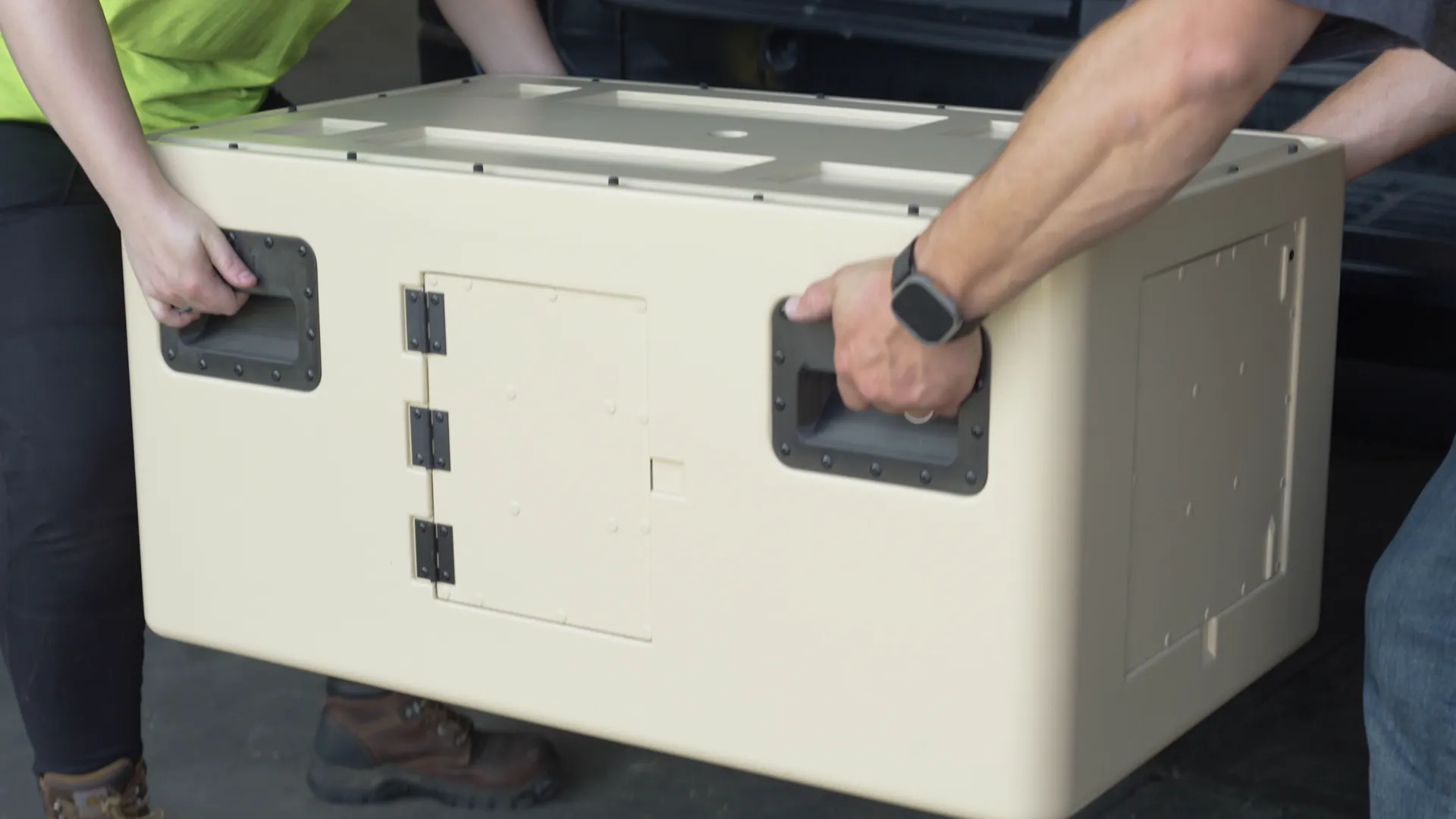
That is the problem UET was built to solve. Our VectorEdge systems bring data center-class GPU compute to austere locations, designed to meet MIL-STD-810H, with no data center required. The VectorEdge Carbon puts four NVIDIA H200 GPUs in a two-person-portable unit, enough to run serious AI workloads at the tactical edge.

// Looking Ahead
As the military continues to invest in AI, it needs to make an equally serious investment in the computing infrastructure required to support it. The capabilities being developed demand significant processing power, and that doesn’t change just because they’re being deployed in a desert, on a ship, or in a remote operating environment.
The next competitive advantage in military AI may not come from developing another algorithm. It may come from ensuring that the algorithms we already possess can operate reliably at the tactical edge, under the most demanding conditions imaginable. That is the last mile of AI warfare.
At UET, we’re focused on delivering the computing infrastructure necessary to make that possible. To see VectorEdge in person, connect with our team.