
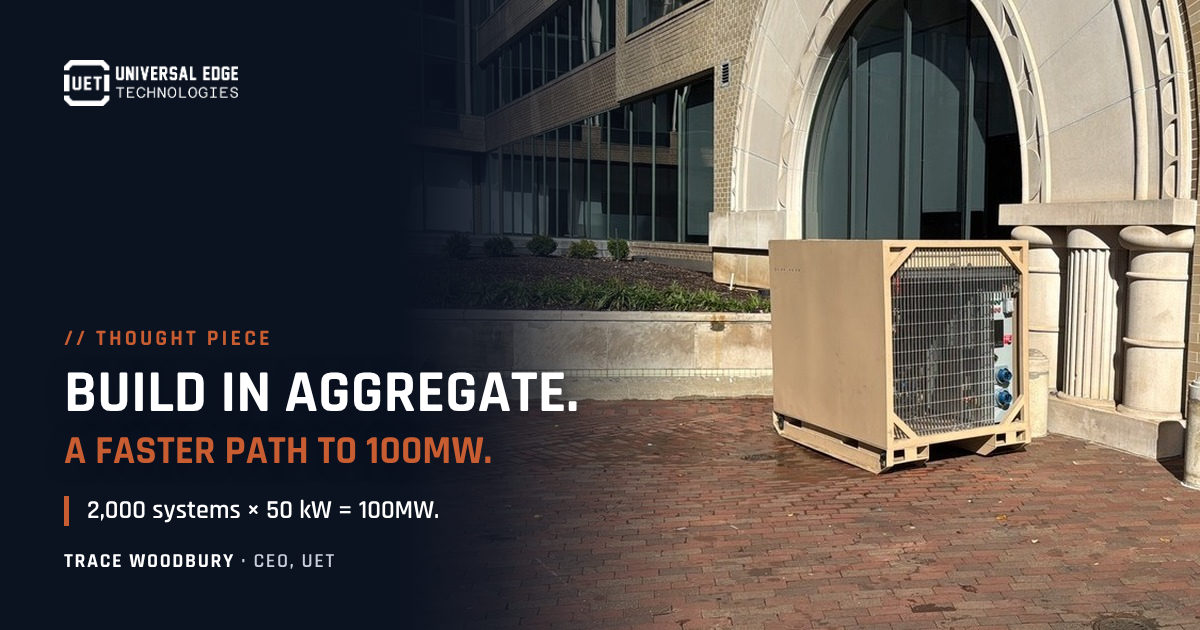
The next 100MW of AI capacity may not come from one massive data center. It can come from 2,000 smaller deployments, placed on infrastructure that already exists.

Every AI roadmap I see hits the same wall, and it is not GPUs. It is power, permitting and community approval. Companies are spending billions on GPUs and models, yet the infrastructure to put that compute to work cannot keep pace.
The conventional answer is to build bigger. I believe we should also think smaller. Rather than asking where to build one 100MW data center, ask where to deploy it in 50 kW building blocks, one site at a time.
// The problem with building everything in one place
The national average wait for utility power is now about four years, up from 12 to 18 months in 2022 (JLL 2026 Global Data Center Outlook, via EC Mag). Large power transformers take 2 to 4 years to arrive. Texas has about 410 GW of large loads waiting in its grid queue, roughly five times its current generating capacity (Construction Owners).
Power is only the first gate. Permits and approvals alone typically take 6 to 18 months, and contested projects have waited more than two years (Data Center Knowledge). The construction industry needs up to 349,000 more workers in 2026, and some data center builds already carry backlogs of about eight and a half months (Associated Builders and Contractors, via DCD).
The result: a project can spend years consuming capital before producing a single dollar of compute revenue, while the GPUs bought for it age.
Time to operation is becoming as important as cost of construction.
// One hundred megawatts does not need one address
UET’s VectorEdge Large is a ruggedized, immersion-cooled AI platform with 24 or more NVIDIA H200 NVL GPUs. It runs without a data hall or external HVAC, and it arrives ready to run: the site provides power and network connectivity, and UET brings the cooling.

A VectorEdge Large draws 35 to 50 kW, depending on environment and workload.
Fifty kilowatts is roughly one dense rack. Many existing properties have that today, or can get it through a service upgrade from a local electrical contractor instead of a utility queue. Big-box retail stores, distribution centers, industrial plants, hospital campuses and government installations all carry substantial electrical service and space. A small site might host one system. A larger one might host ten or more.
Not every site qualifies. Power must be verified, electrical distribution may need upgrades, connectivity must fit the workload, and local requirements still apply. Evaluating an existing property is still a fundamentally different job than developing a 100MW campus from the ground up.
// Stop waiting for the last megawatt
A centralized campus produces nothing until it is finished. A distributed network produces value from the first site. The first system can serve customers while the next fifty are installed, and the first fifty can run while the next five hundred are wired.

That changes the financial model. Capital goes out in stages, matched to customer demand, and starts earning before the full 100MW exists. Hardware is refreshed progressively instead of locking an entire deployment into one GPU generation. Capacity lands where demand is strongest, not wherever a large utility interconnection happens to be available.
Capacity also arrives on the electrician’s schedule, not the utility’s. A local electrician and a network technician can bring a site online. A hyperscale campus competes with every other campus for the same scarce specialized crews.
// Inference changes the equation
Inference now accounts for roughly two-thirds of all AI compute, up from a third in 2023 (Deloitte 2026 TMT Predictions). TrendForce expects inference compute at the five largest North American cloud providers to grow about 122% in 2026, versus 56% for training (TrendForce).
Training the largest models takes thousands of GPUs on one tightly coupled, high-bandwidth fabric. That work belongs in large, centralized facilities. Inference is different. A trained model must answer users, analyze video, support applications and make decisions, and much of that work runs well on independent systems or regional clusters:
- A hospital needs AI close to sensitive patient data.
- A manufacturer needs real-time computer vision on the production line.
- A retailer or logistics operator wants video analytics across dozens of locations without backhauling every stream.
- A financial institution needs compute that respects data residency and latency requirements.
- A military unit needs AI processing where access to a centralized cloud cannot be assumed.
These customers do not need all their compute at one address. They need the right compute where their applications run. Coordinating that work across sites is handled by orchestration software already available on the market.
// Smaller sites change the community conversation
Local opposition blocked or delayed at least 75 U.S. data center projects worth about $130 billion in Q1 2026 alone, roughly matching all of 2025 (Data Center Watch). Citizen groups challenging new projects more than doubled that quarter, from 396 to 833 across 49 states (Fortune). New York has paused state permits for data centers of 50 MW or more, and more than 300 towns, cities and counties have voted to halt new projects (SemiAnalysis). Their concerns about electricity prices, water, land use and noise are legitimate.
A system placed at an existing property requires far less new construction than a greenfield campus. Large campuses that cool with water can consume up to 5 million gallons a day (Environmental and Energy Study Institute). UET systems use single-phase immersion cooling, not evaporative cooling, so they do not compete with the community for water and produce no wastewater.
Every installation still needs evaluation for electrical load, noise and heat. That is a far more practical conversation with property owners, utilities and neighbors than a new 200-acre campus.
// Distribution is a resilience strategy
A large campus concentrates capacity, power demand and risk at one address. That risk is no longer theoretical. Drones reportedly struck AWS data centers in the UAE and Bahrain in March 2026, and Amazon advised customers to shift workloads to unaffected regions (Opinio Juris).

One strike, storm or grid failure can take a campus offline. Two thousand sites force an adversary, or bad luck, to hit each one, while properly designed applications keep running across the rest. Militaries call it dispersal. Enterprises call it business continuity.
Distribution alone does not guarantee resilience. It still takes sound networking, cybersecurity and recovery planning. It does give operators options a single site cannot. I made the battlefield case in The First AI War Proved One Thing: Compute Must Move to the Edge; the same logic now applies to every organization that depends on AI.
// The economics of speed
The industry measures progress in megawatts planned, under construction and commissioned. I would add one more: megawatts producing useful compute today.
A 100MW campus that comes online years from now may be valuable. Ten megawatts deployed this year, another 20 next year and more as demand develops is a different proposition: shorter time from capital to revenue, less infrastructure bought ahead of demand, and hardware that stays current.
// Big campuses still matter
This is not an argument that hyperscale data centers are obsolete. They remain essential for frontier-model training and other tightly coupled workloads. Commercial inference, enterprise AI, industrial applications and tactical-edge computing are different. Their answer is a network of smaller, high-performance systems working together.
The industry has spent years asking where the next giant AI data center will be built. The better question is how much AI capacity we can put to work right now, using the infrastructure we already have.
Build big if you can wait. Build in aggregate if you can’t.
To see VectorEdge Large in person, connect with our team.