Data sovereignty is decided by where compute sits and who controls it. Contracts cannot fix geography.

Microsoft announced on October 20 that its sovereign cloud will run AI models fully offline on customers’ own premises, with the master encryption key held on hardware the customer owns. A European partner will now oversee when Microsoft engineers log in to production systems.
Read that again. The largest cloud provider in the world just defined sovereignty as local hardware, customer-held keys and limits on who can reach in from outside. That is the right definition. It is also an admission that a cloud region and a contract were never enough.
Data sovereignty used to live in the legal department. It is now an infrastructure decision, and it rests on one fact: where the compute physically sits, and who controls it.
// A contract is not a border
A report from the European Centre for International Political Economy (ECIPE), covered by The Register on October 19, reviewed 8,725 public cloud contracts across nine EU member states. Every contract that used sovereignty language went to a domestic provider. Many of those winners run on U.S. hyperscaler infrastructure. Sovereignty attached to the operator’s nationality, not to the hardware.
That gap matters because of the U.S. CLOUD Act, which can reach data held by U.S. providers regardless of where the server sits. Microsoft’s legal director for France told a French Senate inquiry under oath in 2025 that the company could not guarantee French public-sector data would be shielded from U.S. demands. Region selection, encryption and contract language all help. None of them change which nation’s law governs whoever holds the hardware.
ECIPE recommends defining sovereignty as a demonstrated outcome, not an ownership status. I agree. The test is simple: can anyone outside your organization reach your data without your consent?
// The business case goes beyond compliance
Regulation starts the conversation. It does not finish it.
- Penalties are real. European regulators issued about €1.2 billion in GDPR fines in 2025. The largest, €530 million against TikTok, was for transferring European data to China.
- Proprietary data is the moat. Models are becoming commodities. The data used to fine-tune and ground them is not. Sending it to infrastructure you do not control gives away the one asset competitors cannot buy.
- Dependency is a risk. A 2026 BARC survey of 320 companies found the share pursuing cloud repatriation doubled in one year, from 8% to 16%.
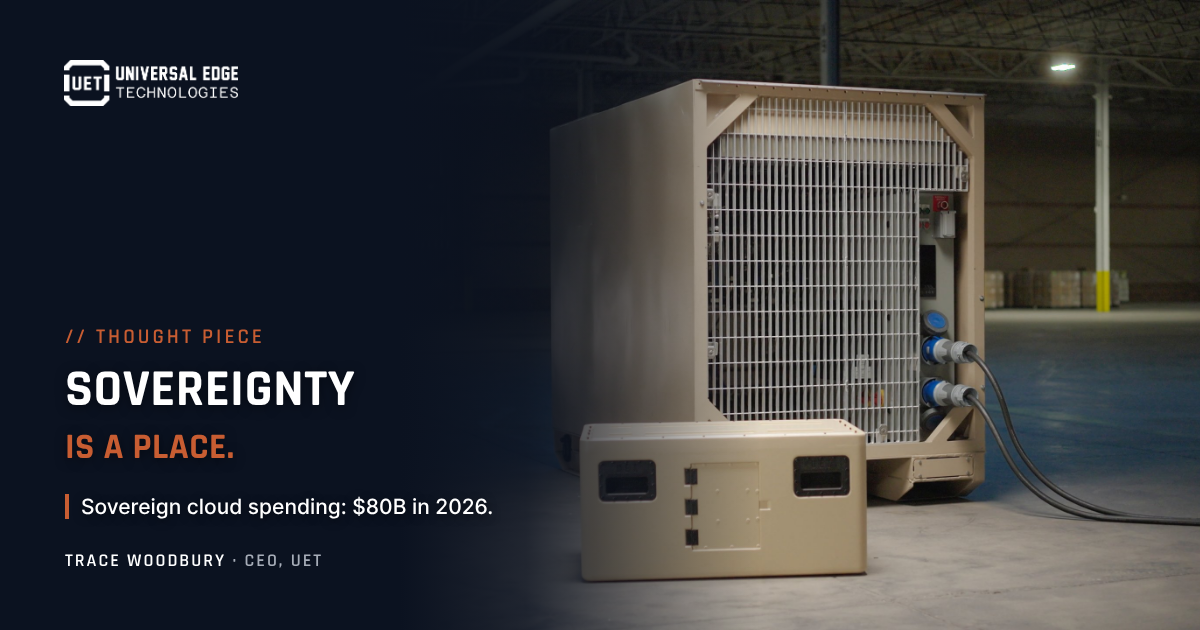
Governments are spending accordingly. Gartner forecasts sovereign cloud spending of $80 billion in 2026, up 35.6%, with governments as the largest buyers.
// The world is drawing borders
The 2026 USTR National Trade Estimate Report flags data localization or sovereignty measures in 30 countries plus the EU, and its references to cloud and data localization rose about 50% in one year. China and Russia require domestic storage. India’s new data protection rules let the government bar specified data from leaving the country. Saudi Arabia, the UAE, South Korea and Vietnam regulate where cloud data lives. The United States restricts sensitive data flows to six countries of concern, and ITAR and CMMC govern where defense data can sit.
Washington calls these trade barriers. The countries passing them call them national security. Either way, no single location satisfies all of them.
// AI raises the stakes
Traditional applications store data. AI applications move it. Every prompt, document and sensor feed sent to a model travels to wherever the GPUs are. If the GPUs sit in another jurisdiction, so does the data while it is processed, and that is long enough to matter.
The obvious answer is to build sovereign data centers. The problem is time. The EU’s AI Gigafactories will not award funding until early 2027, and the average time to power a new U.S. data center is now about four years. Sovereignty mandates are arriving faster than sovereign facilities can be built.
Physical control matters too. Drones reportedly struck AWS data centers in the UAE and Bahrain in March 2026. Data concentrated in one facility is only as sovereign as that facility is defensible. I made the defense version of this argument in April: The First AI War Proved One Thing: Compute Must Move to the Edge.
// Bring the compute to the data
Microsoft’s announcement confirms the direction: sovereign AI runs where the data lives. The open question is whether that requires a data center. It does not.
Local AI no longer means second-rate AI. Epoch AI found that since January 2026, the best open-weight models have trailed the closed frontier by about four months on average. An organization can run a near-frontier model on hardware it owns and keep its prompts, documents and fine-tuning data inside its own walls.
UET’s VectorEdge systems put data center-class GPUs on the customer’s own site, inside the customer’s jurisdiction, under the customer’s control. UET brings the cooling. The customer provides power and network.
- VectorEdge Large carries 24+ NVIDIA H200 NVL GPUs with single-phase immersion cooling and needs no data hall or external HVAC. A bank, hospital, ministry or factory can run AI on its own premises at 35 to 50 kW, with no evaporative cooling and no wastewater.
- VectorEdge Carbon puts four NVIDIA H200 GPUs (or four RTX PRO 6000 Blackwell Server Edition GPUs) and 1TB of memory in a two-person-portable system designed to meet MIL-STD-810H, for sovereign compute where there is no building at all.

UET sells the systems outright. Once a system is delivered, we have no access to it. What remains is the owner’s decision: the software they install and the security boundary they set.
The data never has to leave the room to be useful. That is sovereignty you can point to.
// Five questions to ask your AI provider
- Which country’s law governs the company that holds the hardware?
- Where are prompts and outputs processed, not just stored?
- Who holds the encryption keys, and can the provider be compelled to hand them over?
- Who outside your organization can log in to the system, and who approves it?
- How long would it take to move the workload in-country if the law changed next year?
Vague answers mean sovereignty is a promise, not a property.
// Own where it runs
Sovereignty is often framed as policy versus innovation. That framing is wrong. The organizations that scale AI fastest will be the ones that never need permission to use their own data. That starts with owning where it runs.