
The twentieth century was defined by the expansion of our ability to deliver electricity wherever and whenever it was needed. The twenty-first may be defined by our ability to deliver intelligence the same way.

A century ago, factories clustered around sources of electrical power. Industrial production depended on proximity to generating capacity, and the geography of electricity helped determine the geography of economic opportunity. Electrical grids changed everything. Electricity stopped being a destination and became infrastructure. Even inside the factory, the payoff came only when power was distributed.
As economist Paul David showed in The Dynamo and the Computer, early electrified plants simply swapped a steam engine for one large motor turning a central shaft. Productivity surged decades later when small motors were placed at each machine. The century that followed built both large central power plants and distributed microgrids. AI is approaching a similar turning point, one that may expand centralized AI “generation” and also give rise to a new category of infrastructure: distributed AI microgrids.
That arrangement, a motor at each machine, is known as the unit drive. It made machines faster and let factories be laid out around the work instead of around a shaft. A cognitive unit drive, intelligence placed at each machine, will reach further. It optimizes the system, not only the machine: anticipating failures before they stop a line, adjusting to conditions as they change and coordinating machines across the facility. The economic gain will come less from running faster than from eliminating downtime.
Today, most people experience AI as a service delivered from somewhere else. A request travels to a remote data center, powerful computers process it, and an answer returns. That model works remarkably well. What happens when AI becomes essential to operating a hospital, running automated systems in a factory, protecting critical infrastructure, or supporting military or similarly sensitive operations? What happens when the network fails, or the information is too sensitive to transmit over long distances, or a decision cannot wait?
Intelligence then can no longer be something you simply access when convenient. Increasingly, it will become something you can produce locally.
// The AI Microgrid
There is an instructive parallel in electrical infrastructure. Economies of scale drove power systems to rely on large central generating stations connected to extensive transmission networks. That model remains indispensable, but some customers needed the ability to operate independently when the larger grid became unavailable.
The answer was the microgrid: a local electrical system capable of operating alongside the main grid or, when properly equipped, independently of it. Hospitals, military installations and industrial facilities increasingly adopted this approach, in part or in whole. Most do not abandon the larger grid. They reduce their dependence on it for uninterrupted power. Now apply that principle to AI.
A centralized AI cloud resembles a large power station: enormous capacity, economies of scale and extraordinary capabilities. A factory, hospital or military installation, however, may need the computational equivalent of a microgrid, a local source of intelligence that operates alongside the cloud, or completely isolated from it, while retaining the ability to perform essential functions when connectivity disappears.
Call it an AI microgrid. Imagine a manufacturing facility where cameras, sensors and automated systems continuously monitor production. AI identifies defects, anticipates equipment failures and coordinates operations. Instead of transmitting every piece of information to a distant data center, substantial computing capacity operates locally at the facility. When connectivity is available, the system exchanges information and receives updates, sends backups and shares data for deeper, longer-term analysis. When connectivity is interrupted, properly designed local applications continue operating.
The same principle applies to healthcare, transportation, energy infrastructure and national defense. For most applications, distributed compute does not eliminate centralized computing. It reduces dependence on it.
Some decisions cannot wait for a round trip. Work happens where power and a control signal meet the machine: a robotic arm, an industrial valve, a defense system. A two-second delay is acceptable for a chatbot. It is not acceptable for a production line moving at speed or a system defending against a drone. When a control loop must close in milliseconds, an unpredictable network connection cannot sit between the sensor and the actuator. That intelligence has to live next to the machine.
There is a practical catch. An electrical microgrid makes its own power; an AI microgrid still needs electricity from somewhere. Some sites will operate an AI microgrid on grid power because they need local AI for speed, security or control of their data. Where reliability matters most, the AI microgrid can pair with a local power microgrid. That points to its most natural homes: places that already generate or store their own power, such as electric utility battery sites, commercial solar installations, hospital backup systems and military microgrids. Power produced on site or held in reserve can run local inference, giving those assets a second source of value. Utilities and energy developers are already asking this question, and that conversation is just beginning.
Google expanded its virtual power plant with Voltus on October 22, growing it from 100 megawatts to 1 gigawatt across PJM, the largest grid market in the United States. Voltus assembles that capacity from businesses and homes that adjust their energy use when the grid is stressed. Google called it “one of the largest known distributed capacity portfolios deployed by a hyperscaler to date.” Four months ago, the same program was 100 megawatts.
The size is now part of the signal. When large connections take years, the grid is learning to count many small resources as one, and it is doing it at gigawatt scale. AI compute is headed the same way.
// Intelligence Is Becoming Infrastructure
As AI becomes embedded in essential operations, access to computing intelligence will increasingly resemble access to electricity or telecommunications: an operational requirement rather than an optional software feature. Mark Mills, in his book The Cloud Revolution, described the cloud as the first foundationally new infrastructure in nearly a century. The next step is expanding it both globally and locally.
The International Energy Agency projects that global data-center electricity consumption could more than double by 2030. The physical infrastructure supporting AI is expanding at an extraordinary pace. Much of the conversation, however, remains focused on building ever-larger centralized facilities.
That raises a fundamental question: Are we building AI infrastructure only to concentrate intelligence, or are we also building the means to distribute it wherever it creates value?
Both approaches are necessary. Massive centralized facilities will remain essential for training advanced AI models and running tightly interconnected workloads, or for tasks that depend on economies of scale. Inference, the process of using trained models to generate predictions, answers and decisions, will increasingly need geographic distribution. Deloitte projects inference will account for roughly two-thirds of AI compute in 2026.
Edge and distributed AI will not replace hyperscale data centers. As AI use cases expand and inference becomes the leading use of AI compute, the need grows to place the appropriate computing capacity where it can do the most good. As UET laid out in Build in Aggregate, inference capacity can be installed in stages at sites that already have power and fiber, such as big-box retail stores, industrial buildings, distribution centers, hospitals and government facilities, with each site earning as soon as it is ready. Google is now paying for the same logic on the power side.
// The Hardware Must Change
High-performance centralized AI computing requires equally large electrical, cooling and facility infrastructure. That makes conventional GPU installations impractical in many existing buildings. If intelligence is going to become distributed infrastructure, the hardware must become easier to deploy.
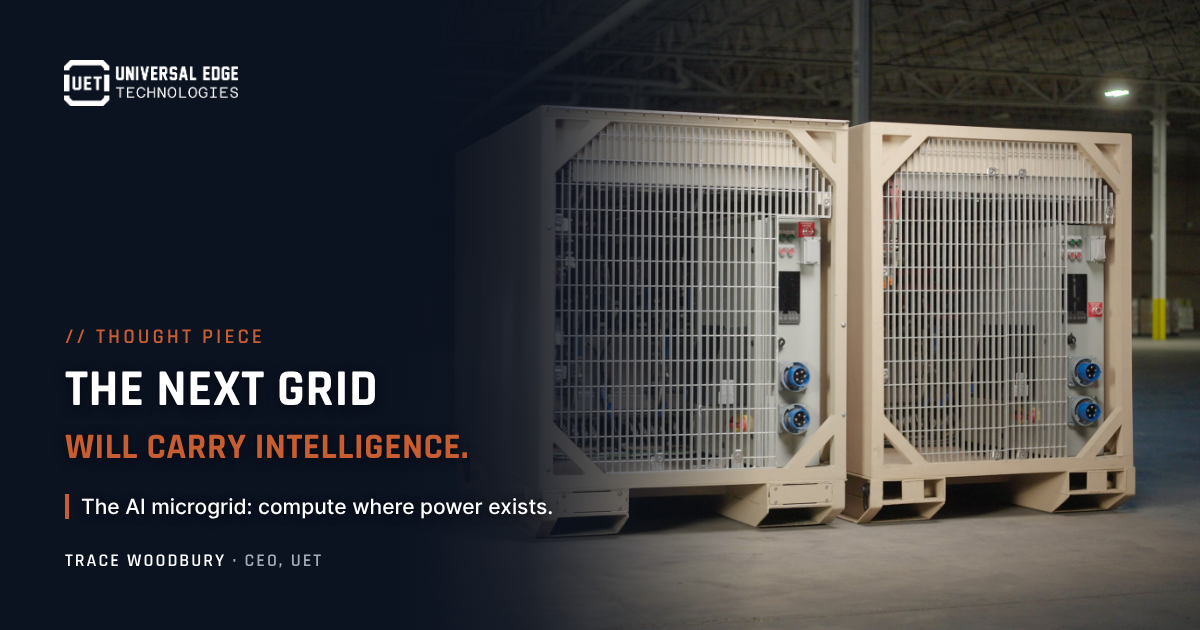
That is the engineering challenge we set out to solve at Universal Edge Technologies. Our VectorEdge systems range from a case two people can carry to a unit moved by forklift. They are built around a sealed container and use single-phase immersion cooling to package high-density GPU computing into compact, modular systems designed for demanding environments. Rather than assuming customers will construct elaborate data-center facilities around the computers, we engineer systems intended to reduce infrastructure requirements so AI at the edge needs little more than power and a local network connection.
The result is an approach designed to bring substantial AI processing capacity closer to where information is generated and decisions are needed, including defense installations, industrial operations, remote environments and distributed commercial infrastructure.
The objective is not to replace the cloud. It is to make sure the cloud is not the only option for important AI workloads.
// The Strategic Value of Independence
There is also a national security dimension that deserves attention. Owning AI software is not the same as controlling the infrastructure required to run it, a question of sovereignty UET took up in “Sovereignty Is a Place.”
The military has long understood this distinction. Communications can fail, networks can be contested, and remote operations cannot always depend on distant infrastructure. Increasingly, civilian industries face their own versions of these challenges.
As AI becomes integral to essential services, operational independence will become a measure of resilience. The defining characteristic of an AI microgrid will not be its GPU count, but its ability to sustain critical functions when external dependencies become unavailable.
// From the Electrical Grid to the AI Grid
The electrical grid transformed the economy by making power widely available. The internet transformed it again by making information accessible almost everywhere. Artificial intelligence represents the next stage: making sophisticated computational intelligence available wherever decisions are made.
That future will require more than larger models and bigger data centers. It will require infrastructure capable of distributing AI processing across the places where people live, work, manufacture and defend themselves. Centralized computing will remain indispensable. Distributed computing will make it more useful, more resilient and more accessible.
The next great infrastructure revolution will not simply connect us to intelligence. It will give us the ability to produce it where we stand.
Connect with our team.